








Sydney
9/255 George Street,
Sydney NSW 2000
02 9221 4066
JANAadmin@jana.com.au


Australian equity managers have largely stopped asking whether passive investing has changed the market. The question now is how to trade, size positions and budget active risk around it. Australian equity managers are now adapting to that change, not just acknowledging it.
JANA’s engagements with managers since January 2025 show how managers’ thinking has shifted, and what it means for investors.
Over the past decade, institutional ownership in the Australian market has grown, and almost all that growth has been passive. Less of the market trades each year, ETF assets have expanded rapidly, and corporate activity has tilted towards buybacks and takeovers rather than new listings. Together, these leave fewer shares available to trade.
The price gap between what buyers will pay and what sellers will accept, known as the spread, has narrowed, which helps anyone trading small amounts. But that gap only describes the very best price on offer, not how many shares are available at it. Volume at those prices has thinned, so a large buyer or seller can push the price against themselves just by trading. Liquidity has also become more episodic, and index-driven flows matter more than they used to. All else equal, this has raised stock-specific volatility, so liquidity now matters even more in shaping how managers size positions.
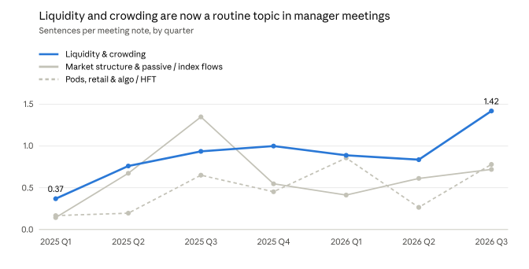
In early 2025, discussions of the evolving market structure were less frequent, and managers mentioned them briefly. By late 2026, discussions are more frequent and cover the rise of quant strategies, regulatory change and passive flows. The chart below tracks how often managers raised three related themes to JANA, by quarter. Liquidity and crowding have moved furthest, from 0.37 sentences per note in early 2025 to 1.42 in the September 2026 quarter.
Source: JANA, Jan 2025 to Sep 2026
Managers now spend less time debating whether passive investing matters and more time on what it means for liquidity, crowding and execution, and on the behaviour of faster traders, multi-manager pods and retail flow.
Most managers now accept that market structure has changed and that it affects them, most visibly through trading costs, crowding and capacity. That acceptance now shapes how they think about risk management and benchmark awareness.
The adaptations we have observed are mostly practical changes to how a manager navigates the changing market conditions, not changes to its philosophy.
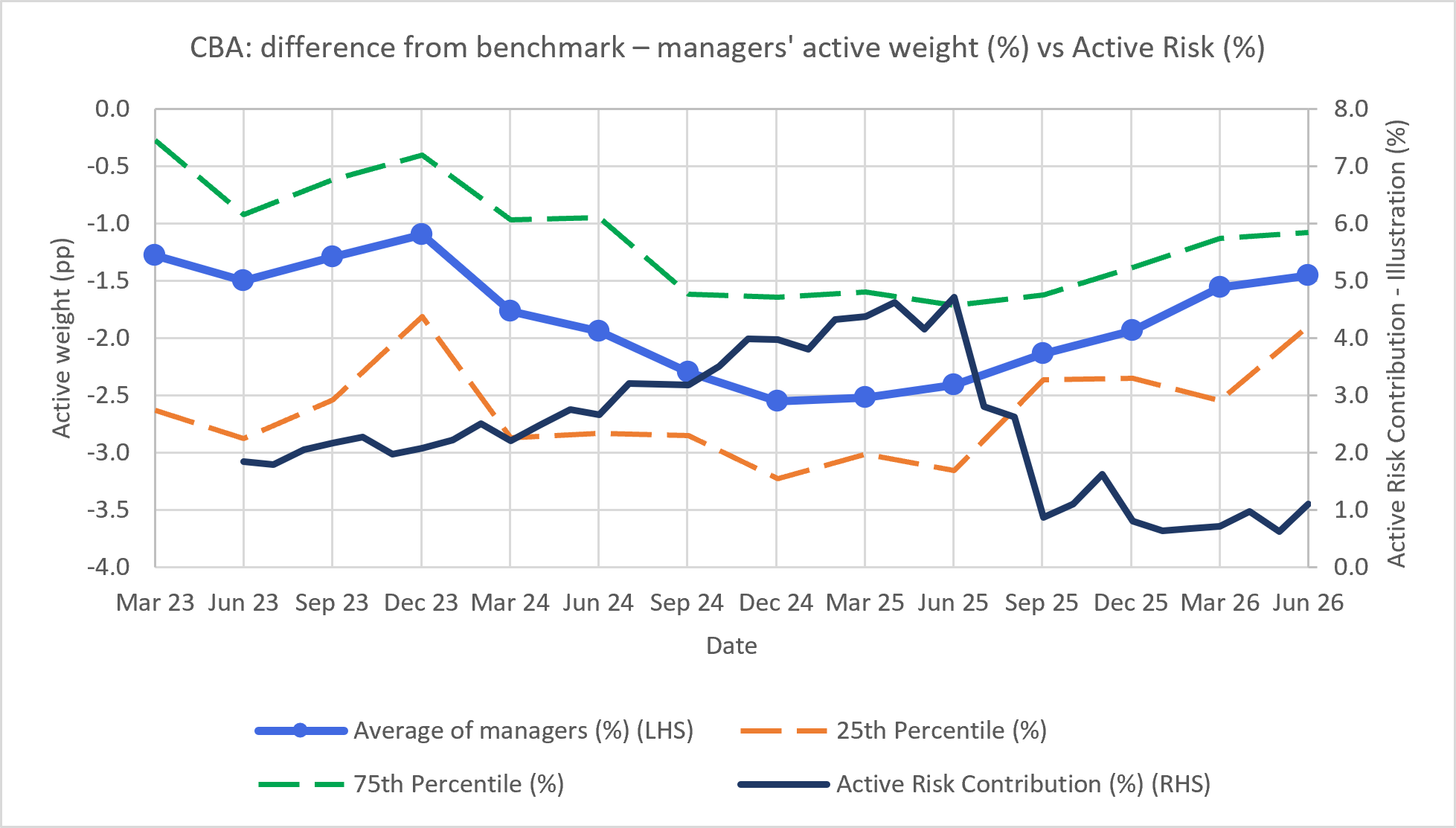
The Commonwealth Bank of Australia (CBA) illustrates this. The chart below plots the average active exposure to CBA across all active Australian equity managers in the eVestment universe and the stock’s average contribution to active risk from March 2023 to June 2026. Over the period, managers have experienced the full effects of market concentration, the rise of passive investing, and other market participants driving CBA’s price/valuation beyond true fundamentals. As a result, the average manager now treats CBA as a risk position, limiting its contribution to tracking error while still expressing a fundamental view through their active weight relative to the benchmark.
Source: eVestment, JANA
On average, Australian equity fundamental managers are becoming more adaptive to changing market dynamics, in both risk management and alpha generation. On risk, they treat large benchmark positions such as CBA as risk positions, deliberately setting and managing the active weight, budgeting its contribution to tracking error, and watching for crowding, rather than letting fundamentals alone set the active weight.
On excess return generation, they are refining their trading, while keeping bottom-up research at the core of their process. Historically, many Australian equity managers ran concentrated portfolios in which large benchmark positions were often underweighted to fund higher-conviction ideas. A more benchmark-aware approach to portfolio construction marks a shift away from that. Over the long term, JANA believes this more benchmark-aware approach to portfolio construction can deliver more consistent risk/return outcomes relative to the Australian equity fundamental manager cohort benchmark. It also lets a manager’s stock-selection skill drive more of the outcome. Investors should evaluate how their active managers are evolving their investment approach in response to these market dynamics, and whether that shows up in how they set their largest positions, budget risk, and manage capacity.

Sydney
9/255 George Street,
Sydney NSW 2000
02 9221 4066
JANAadmin@jana.com.au
Melbourne
18/140 William Street,
Melbourne VIC 3000
03 9602 5400
JANAadmin@jana.com.au


 Functional cookies
Advertising
Social media